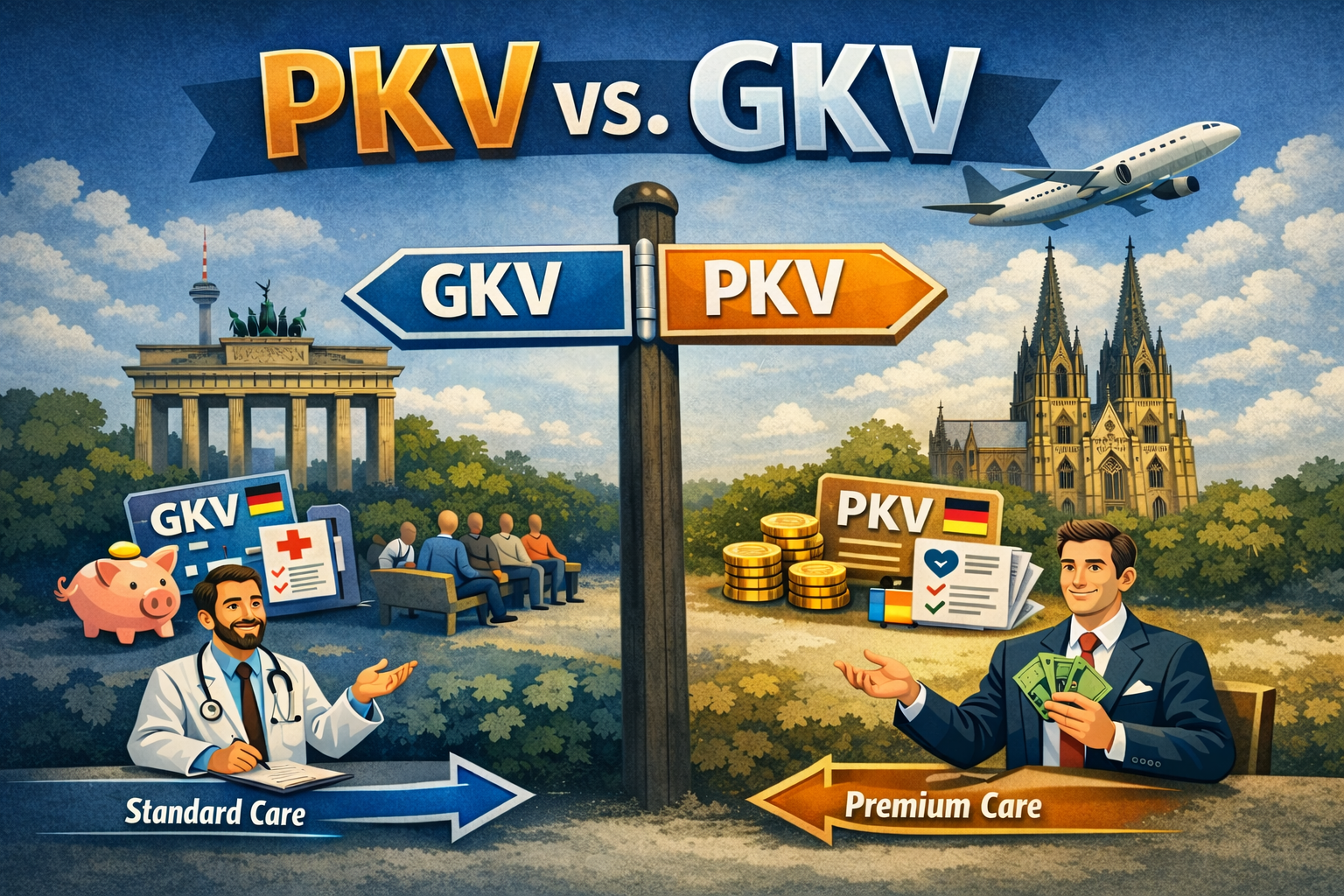
Public or private? The key differences at a glance
Public or private? If you are new to Germany, an important insight is that gesetzliche Krankenversicherung (GKV) and private Krankenversicherung (PKV) are not “two providers” offering the same product. They are two systems built on completely different logic.
GKV, or Public Health Insurance, is highly standardised and income-based. PKV, or Private Health Insurance, is based on an individual contract and depends much more heavily on the tariff, your health profile and the building blocks you choose.
Above all, this article is meant to give you a clear introductory map: What do these terms mean? Who is actually allowed to choose? And where do the fundamental differences lie when it comes to contributions, access and benefits?
Once you understand that, the next step becomes very logical: if you are eligible to choose between the two systems, what actually suits you — your stay in Germany, your family plans, your priorities and your need for security?
That is exactly why I’m currently working on “The 7 questions that help expats make a sensible decision between GKV and PKV.” In that article, soon to be published, you go through the most important decision-making factors step by step — or simply message me directly if you would like an independent assessment in your own language.
But first:
What’s most important in 60 seconds
GKV = gesetzliche Krankenversicherung = Public Health Insurance
- You pay a contribution that is generally based on your income.
- If you are employed and earn less than the Jahresarbeitsentgeltgrenze (JAEG) — the annual income threshold for compulsory insurance — of €77,400 per year in 2026 (around €6,450 per month), you are pflichtversichert — compulsorily insured. That means you can only join GKV, not PKV.
- If, as an employee, you earn above the JAEG, you are freiwillig versichert — voluntarily insured — in GKV. “Voluntary” means that you are allowed to stay in GKV, but you would also be allowed to switch to PKV. Self-employed people in GKV are always voluntarily insured.
- The general contribution rate is 14.6% of your gross income, plus an additional contribution called the Zusatzbeitrag, which varies depending on the Krankenkasse — your Public Health Insurance provider. In 2026, the average additional contribution is 2.9%.
- The GKV system works via so-called “Krankenkassen” – Health Funds if you will. You are free to choose your “Kasse” and can generally switch every 12 months. These insurers must accept everyone under the social principle, regardless of how healthy that person is. This is called Kontrahierungszwang — a legal obligation to accept applicants.
- The benefits offered by Public Health Insurance providers are around 90–95% defined by law, so there is relatively little difference between them.
- If you are insured through GKV, you also pay into gesetzliche Pflegeversicherung — public long-term care insurance. This contribution is currently between 3.6% and 4.2% of your gross salary. Altogether, this means average total contributions of around 21.7% of gross salary in the case of a childless person over the age of 23. The average maximum contribution in 2026 is therefore €1,261.31 per month.
- As an employee, employer and employee usually share the health and long-term care (Pflegeversicherung) contributions equally (except in Saxony, where the long-term care split differs slightly). Self-employed people must pay the full amount themselves.
- Contributions are only calculated up to a certain income threshold known as the Beitragsbemessungsgrenze — the contribution assessment ceiling. In 2026, this is €69,750 per year. Because this threshold tends to increase every year, higher-earning expats also end up paying higher GKV contributions over time, even if their salary does not increase.
PKV = private Krankenversicherung = Private Health Insurance
- This system is organised by private insurance companies.
- Each company offers completely different tariffs and benefit components, with its own contract wording and rules (Bedingungswerke). As a result, the differences in benefits between one tariff and another can be enormous. Unlike GKV, the choice of insurer and tariff (or rather: tariff constellation) is absolutely crucial.
- Not everyone is allowed to join PKV at any time. For employees, there are income rules: in 2026, your regular gross annual income must be above the Jahresarbeitsentgeltgrenze (JAEG) of €77,400 per year (around €6,450 per month). Self-employed people usually have a free choice.
- Unlike GKV, Private Health Insurance providers are allowed to decide whether they want to insure you and on what terms. That is why a specialist broker will usually carry out a Risikovoranfrage — a preliminary risk enquiry — with several suitable insurers and tariff combinations, depending on your needs, wishes and budget. Based on an anonymous health profile, the insurers then decide whether they would accept you and, if so, under what conditions.
- The contribution you pay depends mainly on the insurer, the tariff selected, your age, your health status and, where applicable, your Selbstbehalt — excess or deductible.
- If you take out PKV, you must also take out Pflegepflichtversicherung — mandatory long-term care insurance — in addition to your Private Health Insurance. The contribution is based on legally defined actuarial rules, but for higher earners it is generally lower than in GKV.
- In PKV, employer and employee also share the contribution roughly equally in the case of employees, depending on how the tariff is structured. Self-employed people must again pay the full amount themselves.
What you should know as an expat
| Topic | GKV (Public Health Insurance) | PKV (Private Health Insurance) |
| Basic principle | Social principle: “the same for everyone” (highly standardised) | Individual principle: “tailored to you” — you decide what is covered |
| How contributions work | Contribution is a percentage of income plus an additional contribution; tends to rise structurally, especially for higher earners | Contribution depends on tariff, age, health status and deductible; you shape it through components and options |
| Employer contribution | Employees: employer pays 50% of health and long-term care contributions (with a small difference in Saxony) | Employees: usually also receive an employer contribution, up to legal limits and depending on the tariff |
| Acceptance | Acceptance even with serious illness or long-term care needs | Medical underwriting: acceptance and conditions depend on your health profile; an anonymous preliminary risk enquiry is therefore advised |
| Benefits — how large are the differences within the system itself? | Around 90–95% defined by law; insurers differ only slightly | The tariff determines everything: differences between tariffs are huge; premium PKV tariffs can go far beyond entry-level PKV tariffs or GKV in outpatient, hospital, dental and medical technology cover |
| Reserves / financing | Pay-as-you-go system: younger and healthier people finance older and sicker people; no individual reserves | Capital-funded system with reserves — contributions today help support individual costs later |
| System health | Strongly affected by demographic change, which creates structural pressure on contributions | A healthy system that builds up more reserves over time, giving you a degree of control over future contributions |
| Tomorrow and the years after that (system risk) | Historically shaped by repeated reforms, cost controls and benefit restrictions | Contractually defined protection, which means your level of cover is legally agreed |
| Co-payments / deductibles | Typical co-payments for medicines, hospital stays, aids and therapies, for example | Usually a freely selectable deductible, if you choose one |
| Outpatient care (doctors / high-tech medicine / medication) | Standard care within the rules of the system | Depending on the tariff: access to “first-class medicine”, newer treatments, broader doctor choice |
| Hospital treatment | Standard hospital benefits | Depending on the tariff: optional extras such as one- or two-bed room and treatment by a senior consultant |
| Dental | Basic level; mostly with co-payments and limitations | Depending on the tariff: dental benefits are often significantly higher and more premium |
| Refunds | Usually none | Often possible: high refunds are possible if you do not claim, depending on the tariff and insurer |
| Worldwide cover / moving abroad | Mainly focused on Germany and, to some extent, Europe | Depending on the tariff: worldwide cover can be possible, which is particularly relevant for expats |
| Partner / children | In certain situations, partner and children can be included without an additional contribution | Children and lower-earning partners are not covered free of charge; they usually need their own contracts and contributions |
| Changing provider | You can generally switch insurer every 12 months | You do not normally switch Private Health Insurance provider; instead, it should be designed to be future-proof from the outset, with the right options, components and plan |
Conclusion
You will have noticed: GKV and PKV follow completely different rules, create different opportunities and lead to different consequences — today, but even more importantly later on.
Once you understand that basic logic, you are already a big step ahead of most expats.
In an upcoming article, I will show you the 7 specific questions that help you work out which system actually makes sense for your situation as an expat.