What is BU, and why does it matter so much in Germany?
Berufsunfähigkeitsversicherung (BU) — occupational disability insurance — pays you a monthly pension if illness or injury stops you from doing at least 50% of your specific, last-held job, for more than six months. Not "any job you could theoretically do." Your job.
It matters more in Germany than in many other countries for a specific reason: the state's own occupational disability pension was effectively phased out back in 2001 for almost everyone currently working. Anyone born after 1 January 1961 no longer has access to it — only the far stricter, far lower Erwerbsminderungsrente remains as a fallback. For most employees and self-employed people, BU isn't a nice-to-have on top of state protection. For most of the working population, it's the only real protection there is.
Is it actually worth it? Here's how to honestly answer that
Financially, insurance is only ever "worth it" in hindsight — if you end up needing it. Nobody can know in advance whether that will be true for any one individual. What we can know, with much more certainty, is something else: almost anyone can handle a small, predictable financial hit every month. Almost nobody can handle the full financial consequences of actually becoming occupationally disabled.
That asymmetry — small, planable cost vs. potentially catastrophic loss — is the entire case for BU. The rest of this article does the math on exactly how asymmetric it is, using one realistic, deliberately conservative example.
The profile used throughout this article:
- 💼 €80,000 gross per year
- 💶 About €3,955 net per month
- 🎂 30 years old, healthy, non-smoker
- 🛡️ Insures a BU pension of €3,000/month
- 📊 That's about 75% of net income — deliberately conservative; more on why later
1. A small premium next to the insurance you already pay
A note on the KV/PV numbers below, upfront: Germany's 2027 contribution rates and Beitragsbemessungsgrenze (BBG) are not finalised yet. This article uses the forecast figures from the BStabG cabinet draft (approved 29 April 2026): a BBG of €6,374.08/month, an 18.10% KV rate (14.6% base + 3.5% Zusatzbeitrag), and a 4.20% PV rate for childless members. Final figures are set by statutory order in autumn 2026 and could differ. Treat every KV/PV number in this section as a projection, not a confirmed 2027 rate.
Before looking at what BU could pay out, look at what it costs relative to insurance this same person already pays for — without ever questioning it. Two things are worth seeing clearly here: how that insurance is split between employee and employer, and what it actually adds up to.
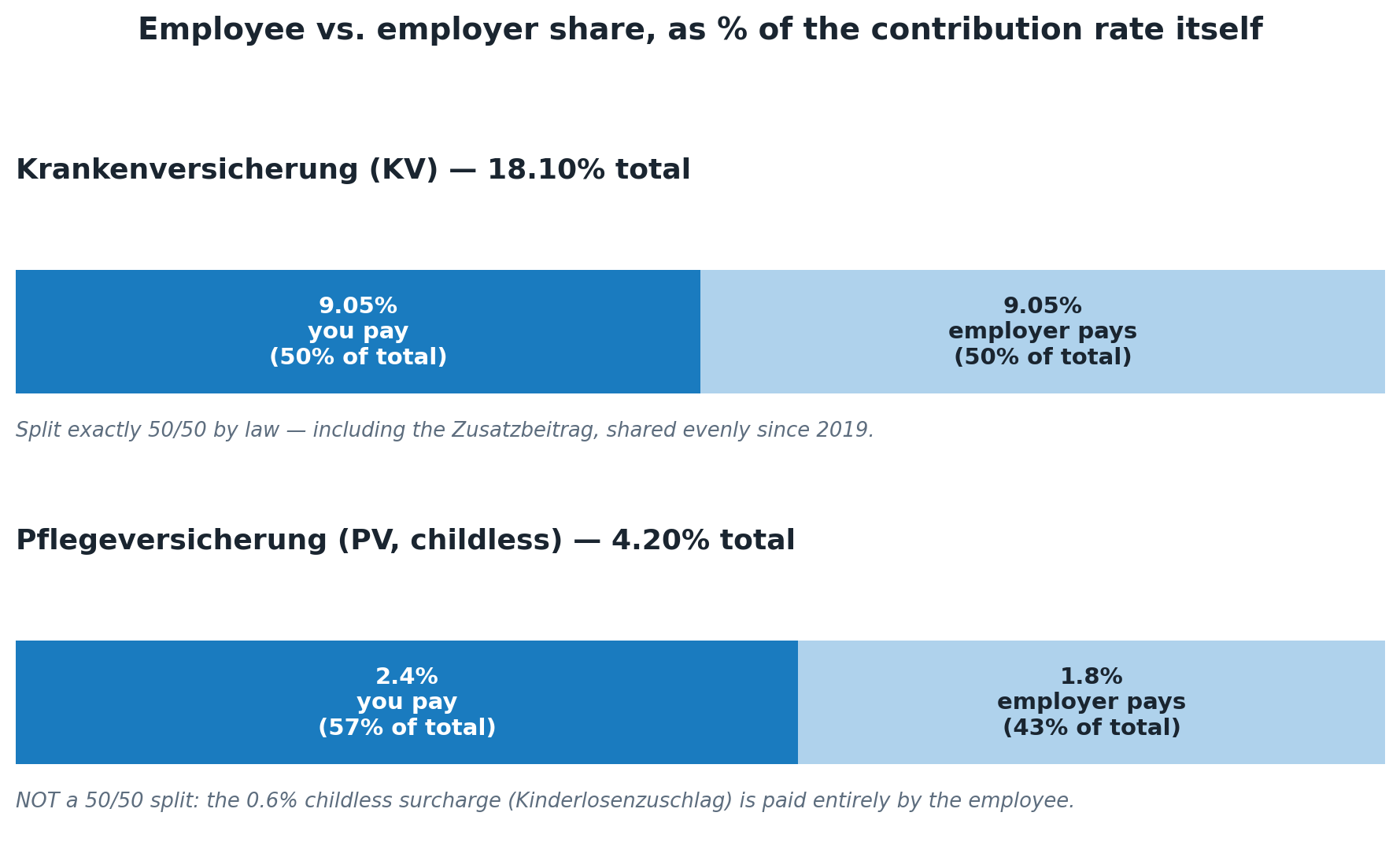
On these projected rates, KV is split exactly down the middle — including the Zusatzbeitrag, which employers stopped being exempt from back in 2019. PV isn't quite as even: the 0.6% childless surcharge (Kinderlosenzuschlag) is paid entirely by the employee, so a childless employee covers 57% of the PV rate, not 50%.
Carry that same 50/50 (and 57/43) split through 37 years of contributions, growing at 3% a year like everything else in this article, and here's what it actually adds up to — with the BU premium alongside it for scale:
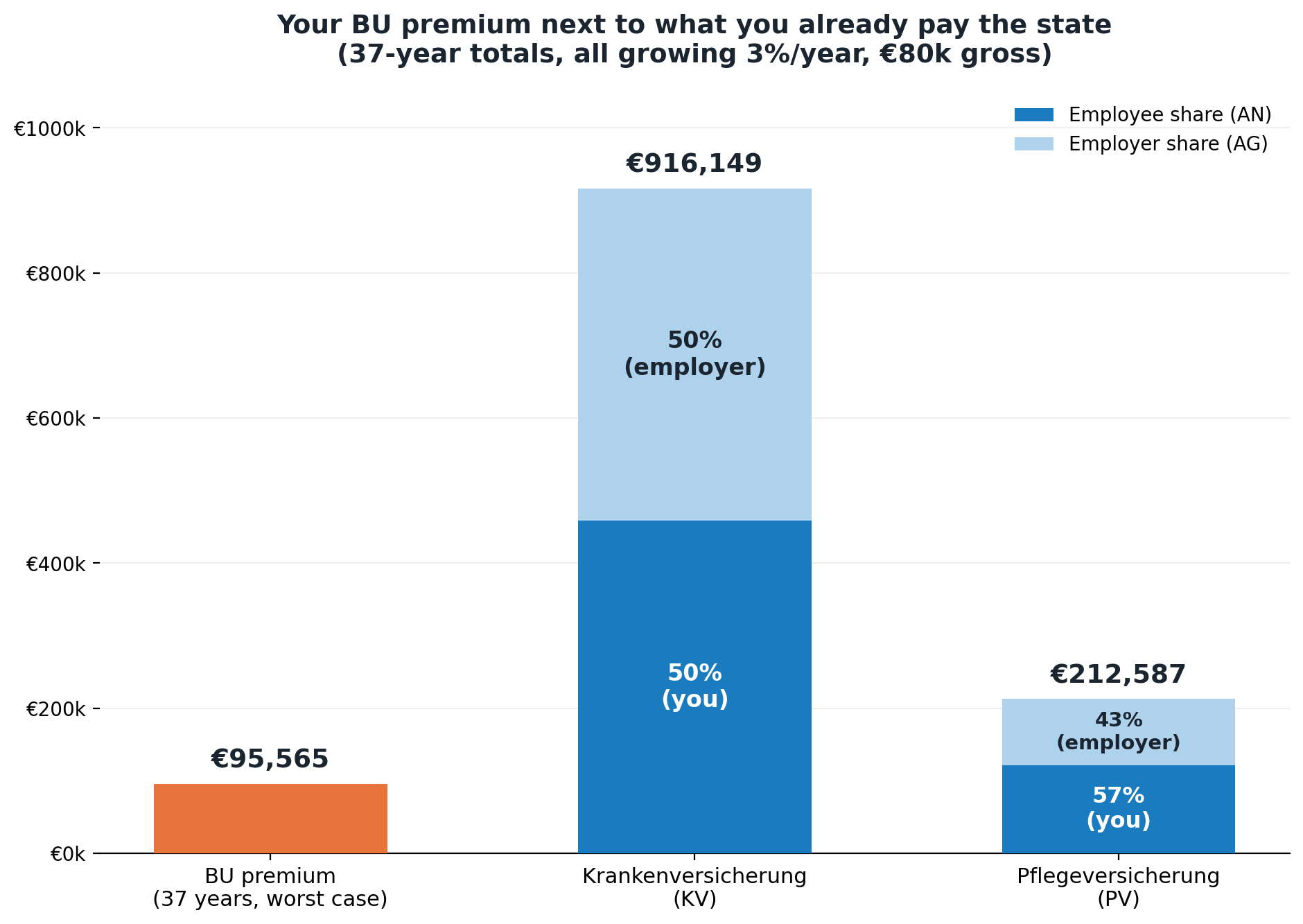
The employer paying half doesn't mean KV and PV don't actually cost that much — it means the true cost is split between two parties instead of one. On these projected rates, the full 37-year cost of KV and PV combined comes to €1,128,736. That's exactly what a self-employed person, with no employer to share the burden, typically pays alone. This person's own, employee-only share of that — the €458,071 + €121,480 they actually see — still comes to €579,551 on its own.
Put the BU premium next to what you personally see on your payslip, and it's about 16% of KV+PV combined. Put it next to the full, true cost — what it actually costs to insure this person's health and long-term care, employer share included — and it's about 8%. Either way you cut it, BU is the cheap line item on this list, not the expensive one — on today's numbers, and very likely still true once the final 2027 rates land, even if the exact percentages shift slightly.
2. The two worst cases, side by side
Here's the answer, and it's the single most important comparison in this article: the two genuine extremes, placed next to each other.
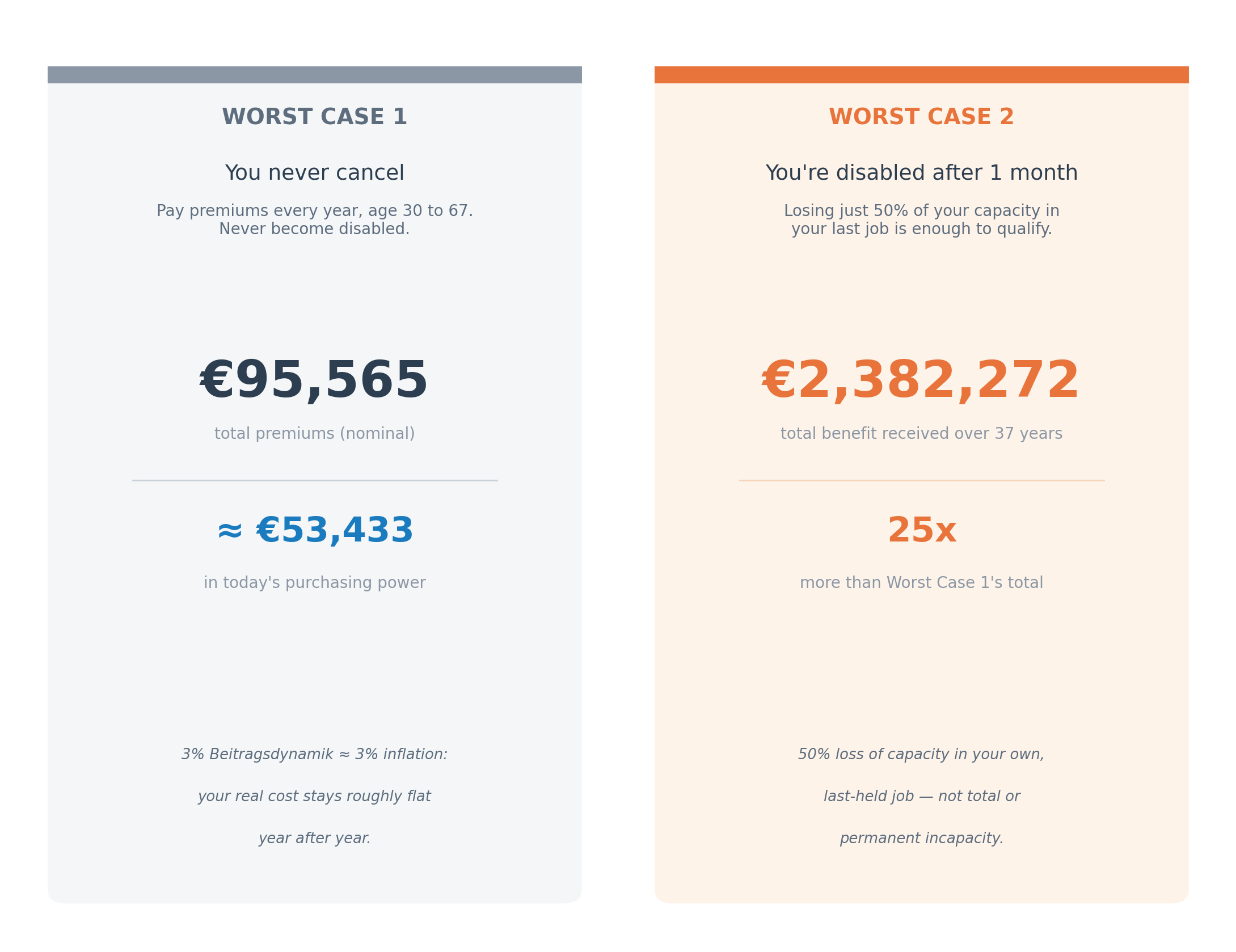
There's a simple asymmetry behind comparing these two extremes: you can always cancel an insurance policy you no longer need. You cannot take one out the moment you suddenly need it. So instead of guessing at "average" outcomes, it's more honest to test both genuine extremes — the worst case if you never claim, against the worst case if you claim almost immediately. If BU still looks like a good deal at both extremes, it looks good everywhere in between.
3. Worst Case 1: paying in for the full 37 years, never claiming
This is the scenario nobody wants to imagine when buying insurance, but it's the fairest one to test: the policyholder pays every premium, every year, from age 30 to 67 — and is never disabled at all.
Most solid BU policies include a Beitragsdynamik: your premium — and, correspondingly, your insured pension — increases automatically each year, without new health questions, so your real coverage doesn't quietly erode as prices rise. This was modelled at 3% a year.
Two things follow from this. First, the total premiums paid over the full 37 years — factoring in that 3% annual increase — come to a nominal €95,565. Second, because the Beitragsdynamik is modelled at exactly the same rate as inflation, the effect is a clean, perfect offset: the insured pension grows to a nominal €8,695/month by year 37, and translated back into today's purchasing power, that's worth exactly €3,000 — precisely what was insured on day one. The Beitragsdynamik isn't adding real value over time; it's preventing your original coverage from quietly losing any.
The same logic applies to what you pay: translate the entire 37-year premium stream back into today's money and it comes to about €53,433 — noticeably less than the €95,565 nominal figure, because later years' payments are worth less in real terms.
4. Worst Case 2: disabled a month after signing
Now the other extreme: disability strikes almost immediately, and the policyholder stays on claim all the way to age 67. Worth repeating, because it's easy to picture BU as covering only catastrophic, permanent disability: the actual bar is losing at least 50% of your capacity to continue in your own, last-held job for more than six months — not total incapacity, not a specific accident, just a 50% threshold in the job you were already doing.
Here, a different mechanism applies: the Leistungsdynamik. Once a claim is being paid, the monthly benefit itself increases every year — again, 3% — so the payout keeps pace with the cost of living over what could be decades on claim. Starting from €3,000/month and compounding at 3% a year for 37 years, the total benefit received adds up to the €2,382,272 shown above — about 25 times Worst Case 1's nominal total.
5. Worst case vs. worst case: how fast do the numbers flip?
Take the absolute most this person could ever pay in — the full €95,565 from Worst Case 1 — and ask how long Worst Case 2's benefit takes to exceed it.
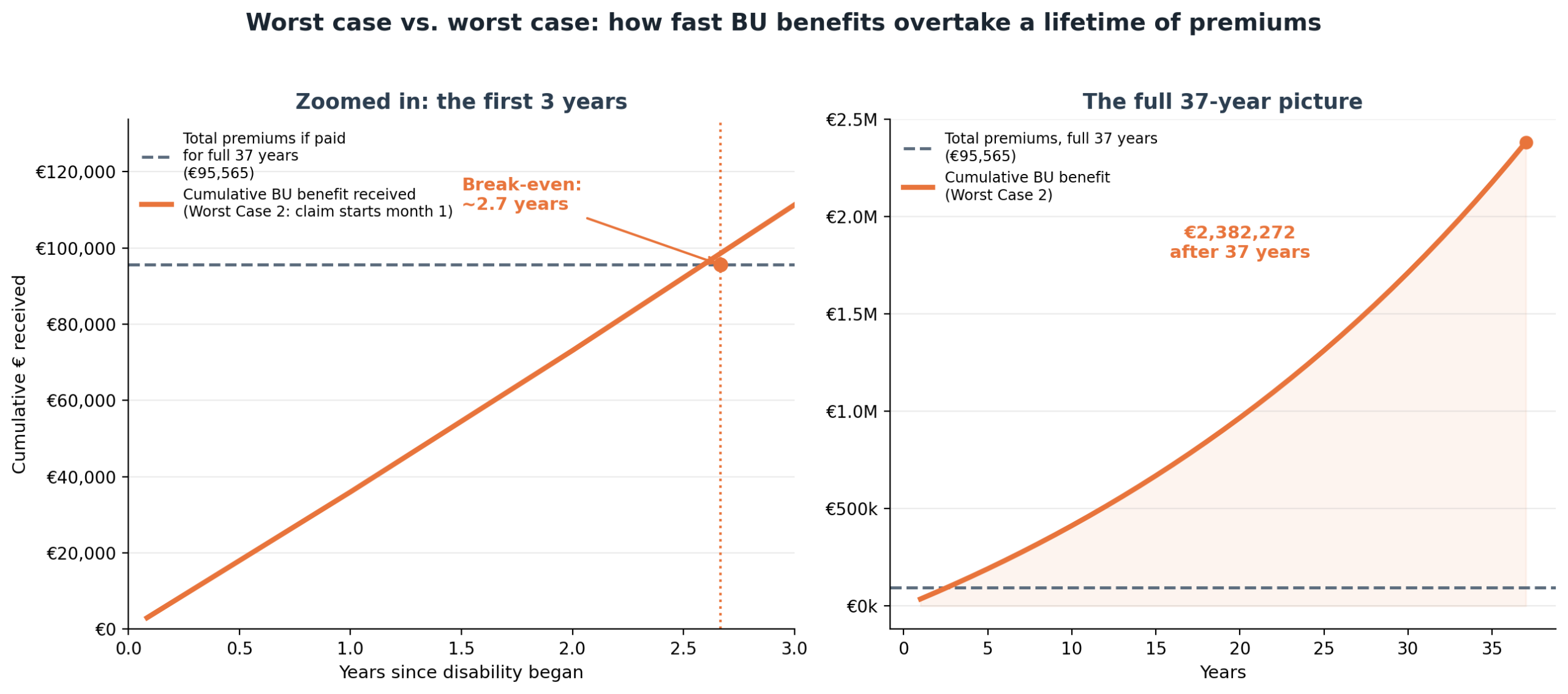
The answer: about 32 months — roughly 2.7 years. After that point, every additional month on claim is money received on top of the single biggest amount this person could ever have paid into the policy across an entire career.
Fazit: the question is really about what you can afford to lose
Strip away the dynamics and the compounding for a moment, and the decision comes down to one plain question: what can you actually afford to lose?
Almost anyone can absorb losing €95,565 spread across an entire 37-year career — that's Worst Case 1, and in today's money it's closer to €53,000. Almost nobody can absorb losing €2.4 million of income. And even that understates it: without BU, a disability doesn't just stop your income — it also stops whatever you'd otherwise have saved and invested toward retirement over those same decades. As a rough illustration only (not a return forecast): setting aside even a modest 10% of income every year and investing it could plausibly be worth over €1.5 million by retirement age, on long-run assumptions. Added to the lost income, the realistic scale of what's at stake if this person becomes disabled uninsured is closer to €3.9 million — not €2.4 million.
That's the actual comparison: a premium that's a small fraction of what you already pay for state insurance, against a risk that very few people could absorb on their own.
One more thing: 75% was the conservative case
Everything above used €3,000/month — about 75% of this person's net income — on purpose, to show that the numbers hold up even under a cautious assumption. It's worth being direct about what a stronger benchmark actually looks like.
The recommendation isn't 75%. It's one of two things: either 100% of net income, or — often more accurate — 100% of your current and realistically projected future expenses, plus a buffer. Income replacement is a reasonable starting point; a needs-based number, built around what you actually spend and expect to spend, is usually the more precise one.
Either way, one detail changes the target further: the BU pension you insure is a gross figure, not a net one. The same deductions that apply to any income apply here — tax, depending on how the policy is structured and how long the disability lasts; health and long-term care contributions, no longer subsidised by an employer; a pension gap, since retirement contributions don't continue automatically once you stop working; and new costs that simply didn't exist before, from therapy to home modifications. That's why the professional rule of thumb is to insure 25–50% more than the net amount, or the expense level, you actually want available each month. Aim for your real number first — then add the margin for what the insurance itself won't hand you net.
One structural limit to know about: insurers typically cap the BU pension they'll let you insure at around 70% of gross income — for this profile, about €4,667/month. Push the "net + 25–50%" math far enough and you can land above that ceiling before you've even reached your real target. When that happens, the gap usually isn't closed by raising the BU sum further — it's closed by adding a complementary product (like Dread Disease or Grundfähigkeit cover) alongside it.
What now?
These numbers are illustrative — the premium is scaled from a real quote for a different coverage amount, and should be checked against an actual offer for your exact profile before you rely on it. For the full picture beyond this single scenario — all the building blocks of income protection, explained in plain language — download the free guide:
📄 Income Protection at a Glance (PDF)
Or, if you want to see your own numbers laid out this clearly — including what 100% of your real needs, not 75%, actually costs — a free, no-obligation first conversation does exactly that, in 20 minutes — in English, German, Dutch, French or Spanish.
Note on the numbers: This is a single illustrative profile (30-year-old, €80,000 gross, €3,000/month BU pension), not individual advice. The starting premium (€120.35/month) is scaled proportionally from a real market quote for €2,000/month of coverage and should be replaced with an actual quote before publishing anything based on it. All KV/PV figures — the 18.10% KV rate (14.6% base + 3.5% Zusatzbeitrag), the 4.20% PV rate for childless members, and the €6,374.08/month Beitragsbemessungsgrenze — are forecast 2027 figures from the BStabG cabinet draft (approved 29 April 2026), not confirmed law. Final figures are set by statutory order in autumn 2026 and may differ. These are grown at 3%/year alongside everything else for consistency — this excludes any further rise in the Zusatzbeitrag rate itself, which has more than doubled since 2022. The employer/employee split assumes standard statutory rules (KV split evenly including the Zusatzbeitrag; PV split evenly on the base rate, with the 0.6% childless surcharge paid solely by the employee). The self-employed comparison assumes a self-employed, voluntarily GKV-insured person pays roughly the full combined contribution. The foregone-retirement-savings figure in the Fazit is a simplified illustration (10% of gross income, invested at an assumed 6% nominal long-term return) — not a financial projection, return forecast, or investment recommendation. Beitragsdynamik, Leistungsdynamik and inflation are all modelled at 3% per year. This article is for general information only and does not constitute individual insurance, tax or financial advice.